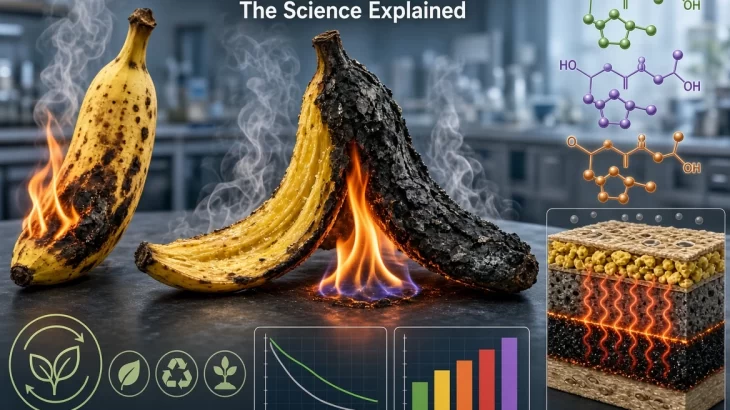
Banana peel fire resistant materials may sound surprising, but scientists have been investigating whether banana-peel waste can help improve the flame resistance of certain materials. The idea is not that an ordinary banana peel is fireproof, but that processed banana-peel material may have useful properties when incorporated into specially designed products.
A banana peel probably isn’t the first thing that comes to mind when you think about fire-resistant materials.
But scientists have been exploring an unusual possibility: could banana peel waste be used to help materials resist flames?
The answer is more interesting than the viral claim that banana peels are simply “fireproof.”
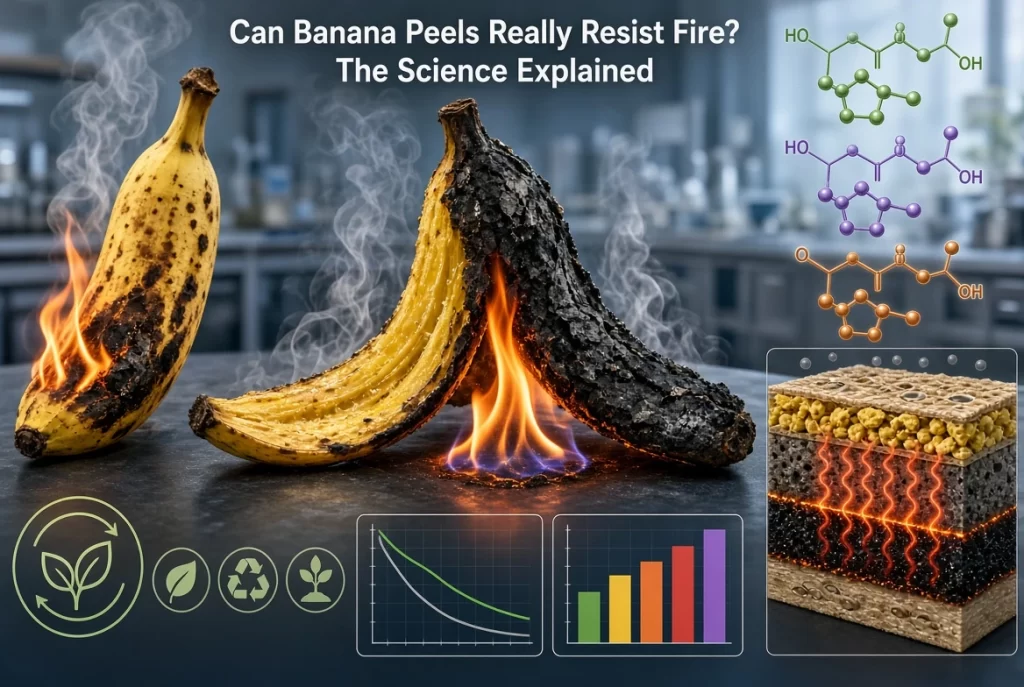
Is a Banana Peel Fireproof?
No.
An ordinary banana peel is an organic material, and it can burn. You shouldn’t treat a fresh banana peel as a fireproof material or assume it can protect something from flames.
The interesting discovery comes from what researchers can do when banana peel is processed and incorporated into other materials.
Scientists have investigated banana-peel powder and other banana-derived materials as components of flame-retardant products.
What Makes Banana Peel Interesting?
Banana peels contain a mixture of natural compounds and mineral components. When processed and used in certain materials, they can contribute to the formation of a char layer during exposure to heat.
This layer can act as a protective barrier. Instead of allowing heat and flames to move through a material as easily, the char can help slow the process.
However, the result depends heavily on how the banana peel is processed and what other materials it is combined with.
That’s why saying “banana peel is fireproof” gives the wrong impression.
Scientists Have Tested It
Research has produced some intriguing results.
One study investigated banana-peel powder in a biodegradable polymer composite. The researchers found that banana-peel powder affected the material’s flame-retardant and thermal properties. When it was combined with an additional flame-retardant ingredient, the composite performed considerably better in standardized testing.
Other researchers have explored banana-peel-based treatments for fabrics.
In one study, banana peel was investigated alongside other plant-based materials as a treatment for cellulosic fabric. The treated materials showed improved flame-retardant behavior during laboratory testing.
More recent research has also examined banana-peel-based coatings for cotton fabrics. The researchers reported delayed ignition and reduced damage during their fire tests compared with untreated fabric.
Why Is This Important?
The research isn’t really about turning a banana peel into a replacement for a fire extinguisher.
Instead, it points toward an interesting possibility: food and agricultural waste could potentially become useful ingredients in new materials.
Banana peels are produced in large quantities and normally have little value after the fruit has been eaten. Finding useful applications for this waste could support the development of more sustainable materials.
Researchers are therefore looking at banana-derived materials for applications ranging from textiles to composite materials.
So, Is the Viral Claim True?
Not exactly.
If someone says, “Banana peels are fireproof,” that’s misleading.
If the claim is that banana-peel-derived material can contribute to flame-resistant materials, there is scientific research supporting that idea.
The distinction matters.
A banana peel sitting in your kitchen isn’t suddenly a fire-resistant shield. The research involves processing the material, combining it with other substances and testing the resulting products under controlled laboratory conditions.
And that’s what makes the story fascinating.
Something as ordinary as a banana peel, usually considered kitchen waste, may contain useful properties that researchers can incorporate into materials designed to slow the effects of fire.
Sometimes, the most interesting scientific discoveries begin with things we normally throw away.