

Have you ever looked at a word and found yourself saying the word instead of the color it is printed in? This simple-looking challenge can reveal something fascinating about how the human brain processes information.
Our brains are made up of two interconnected hemispheres—the left hemisphere and the right hemisphere. Although both sides work together, some mental processes tend to rely more heavily on particular brain networks.
One famous example of competing mental processes is the Stroop effect.
Can You Name the Color Instead of Reading the Word?
Look at a series of color words displayed in different ink colors.
Your task sounds simple:
Say the color of the letters—not the word you see.
For example, if the word BLUE is printed in red ink, your answer should be:
RED
But many people instinctively say “BLUE.”
Why?
Because reading familiar words has become an extremely automatic process for most people. Your brain can recognize and process the written word almost immediately, even when you are deliberately trying to concentrate on something else.
At the same time, you are trying to identify the color of the letters. These two tasks compete for your attention.
The result is often a noticeable pause, hesitation, or mistake.
Why Does This Happen?
The interesting part is that your brain isn’t simply choosing between a “left-brain task” and a “right-brain task.”
Instead, several brain systems are working together to process the information.
Reading the word is highly practiced and automatic. Identifying the color and deliberately naming it requires more focused attention.
When the written word and its color don’t match, your brain has to resolve the conflict between these competing pieces of information.
That’s why something as easy as naming a color can suddenly feel surprisingly difficult.
The Brain Has to Ignore What It Already Knows
Imagine seeing the word GREEN written in yellow.
Your brain immediately recognizes the word “GREEN.” You don’t normally have to consciously decode every letter.
But your actual task is to ignore that automatic response and say YELLOW.
This creates a mental competition:
Automatic response: Read the word → GREEN
Required response: Identify the ink color → YELLOW
The stronger and more automatic the reading response is, the more effort it may take to suppress it.
Does This Really Mean the Left Brain and Right Brain Are Fighting?
Not exactly.
The popular idea that the left hemisphere is purely “logical” while the right hemisphere is purely “creative” is an oversimplification.
The two hemispheres do have some functional specialization, but they constantly communicate with each other and work together on many everyday tasks.
The color-word challenge is better understood as an example of attention, automatic processing, and cognitive interference rather than a literal battle between the left and right sides of the brain.
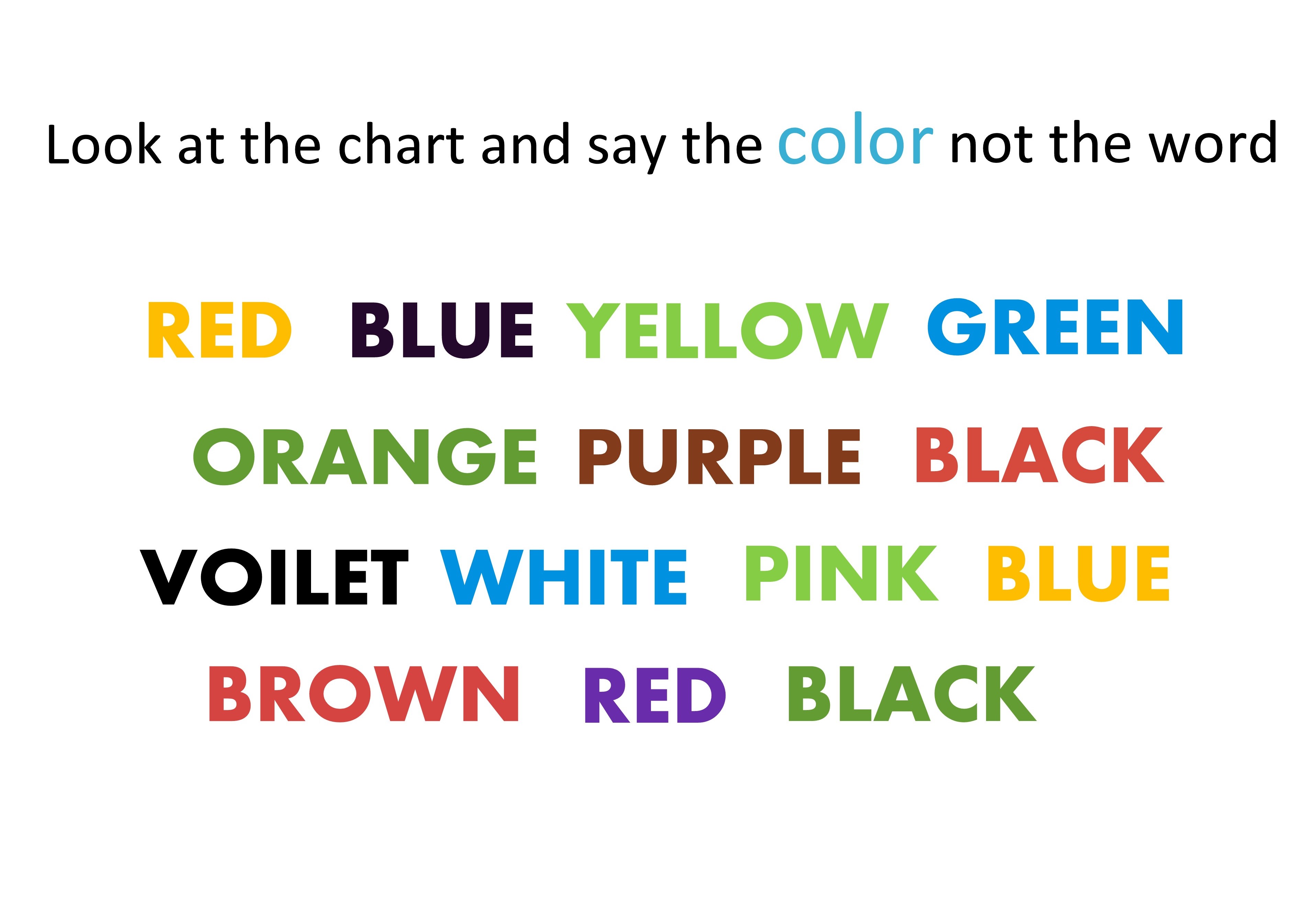
Of course, if reading is difficult for you, it will be pretty easy!
Try the Challenge Yourself
Next time you see a color-word puzzle, don’t read the words.
Instead, concentrate on the color of each word and say the color aloud as quickly as you can.
You may discover that your brain keeps trying to read the word even though you know exactly what the instructions are.
That’s what makes this simple test so fascinating.
Why Is the Stroop Effect Important?
The Stroop effect has become a well-known concept in psychology and neuroscience because it demonstrates how our brains deal with conflicting information.
Researchers can use variations of this type of task to study attention, cognitive control, reaction time, and interference.
It also provides a simple demonstration of an important idea:
Knowing what you should do doesn’t always mean your brain will automatically do it.
Sometimes an old, highly practiced response can compete with the response you consciously want to make.
A Simple Test of Your Attention
The next time you encounter a color-word challenge, try completing it once normally and then repeat it as quickly as possible.
Notice:
- How often you accidentally read the word
- How long you pause before answering
- Whether the task becomes easier with practice
- Whether mismatched colors slow you down
Your brain is constantly filtering information, selecting what deserves attention, and suppressing responses that aren’t useful at that moment.
A simple color-word puzzle gives you a fascinating glimpse into that process.
The next time your brain seems to “betray” you by reading the word instead of naming its color, remember: it’s not malfunctioning. It’s doing what it has been trained to do—read automatically.


